Hey Cow!!

One of the most important goals we have for the Rock Farm is to ensure that we leave it in a better state that we received it.  I am really excited with the soil analysis results we received last week, as it will provide a scientific bench mark that we can use to measure our progress.

Whilst the soil analysis reveals the mineral composition of the soil, it doesn’t reveal much about the biological health of the soil.  This microbial activity is far more important, and if we can get this balance right, we will be doing really well.  It is inspiring to read of people who have used various techniques to actively build top soil and repair the health of their land.  Somehow I believe the key to our survival is in the health of our soil, because from it we derive all our food.

One technique to improve soil health I mentioned in my last post was grazing management.   André Voisin  and later Allan Savory developed what we now call holistic management or cell grazing where soil health can be improved by how you graze the land.

Cell grazing involves heavily grazing small areas over a short period, followed by a long rest.  It is expensive to set up, requiring lots of small paddocks (fencing is ridiculously expensive and water must be provided to all paddocks), and time consuming to manage, as stock need to be rotated frequently.  We are lucky in that the new not-so-rocky Rock Farm was initially established to spell race-horses, so has several small paddocks that we can use for this purpose.

And whilst we have beautiful Wiltipoll sheep to graze our paddocks, sheep prefer eating short grass.  They won’t eat the longer grass, leaving it to go rank.  And I refuse to waste precious diesel slashing long grass for it to mulch back into the soil.

So enter the cows!
img_2819

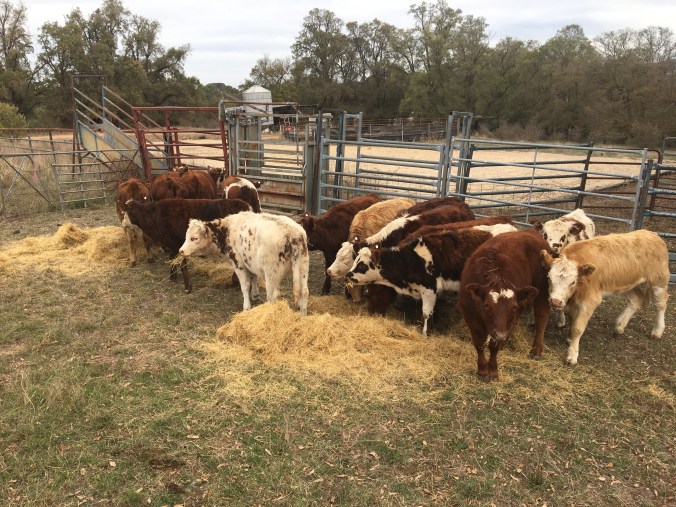
We recently purchased 15 Normande cross weaner hefiers.  Their breeding and the reasons why we chose them is another story entirely. The short story is we wanted quiet cattle, and they had to be any colour other than black!  The Normande is a French beef breed, but you might see that these cattle have an amazing heritage with the best of many breeds in their blood lines.

But for now, they got right on the job.
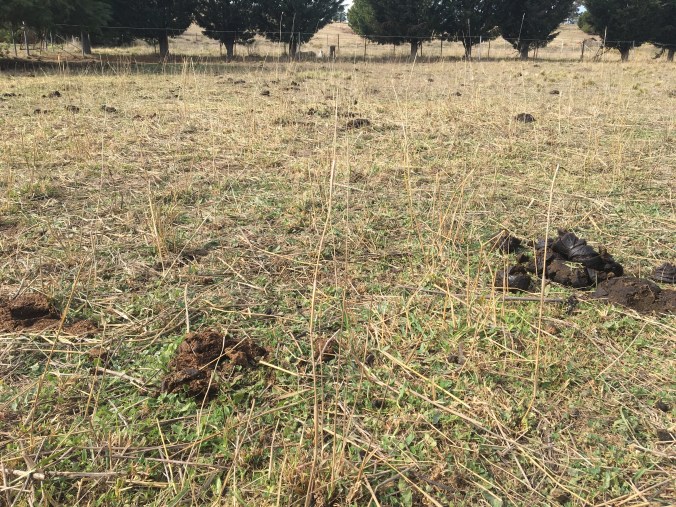
Allan Savory recommends a stocking rate of around 60 head per hectare, which is extremely high.  The cattle will heavily graze the paddock, eating everything including weeds.  Then when the paddock is rested, everything has a chance to recover.  Normal set grazing sees the cattle eating their preferred grasses, and avoiding the weeds.  This eventually leads to a paddock full of weeds that needs expensive sowing to return to pasture.

Just off our yards, we had a small 1/2 hectare paddock, that was perfect for serving two purposes.  It allowed us to spend a week socialising the cattle and it allowed our soil improvement program to get right underway.  Whilst our stocking rate is about half recommended by Savory, we were soon quick to see the results.  Serrated tussock that had been hidden in the long grass was quickly revealed, making it far easier to hack out.
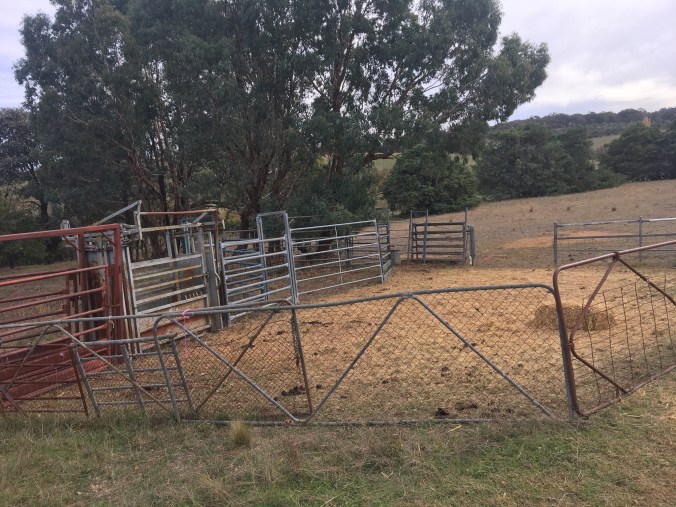
The small paddock was the perfect place for the cattle to be introduced to the Rock Farm.  I set up a water trough in the yards, and kept them in overnight after they arrived.  The cattle were also drenched on arrival, as our paddocks have been free of cattle for a few years and we want to ensure that our worm burden remains low.

For the first week, I fed the young cattle in the yards and let them have full access to the small paddock adjoining the yards.  It was remarkable how quickly they stopped running away from me and started walking towards the yards with only a gentle word or two of encouragement.  In the space of a couple of days, I was able to comfortably push them into the yards by myself, with the minimum of fuss.

I did all my mustering on foot, at a slow measured walk.  I found that walking slowly calmed the cattle down, and they rarely would run away from me.  The cattle are remarkably sensitive to your body language and where you are looking.  A long stick really helps as an extension of your arm, allowing you to direct their movements.  The cattle are also curious and soon were happy to watch me as I watched them eat.
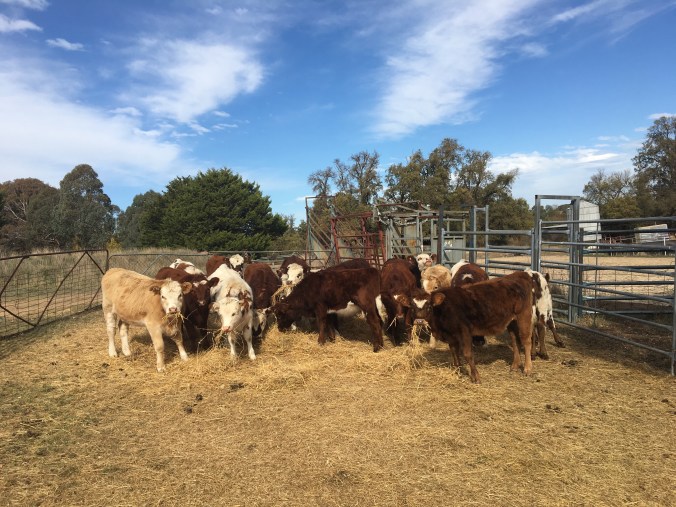
These beautiful cattle have settled it quickly.  We have started moving them around the Rock Farm, and they are learning that a gentle walk is all I want from them.  I am madly trying to fix up fences in the small paddocks in order for me to establish a good rotation for them – it is all good fun.

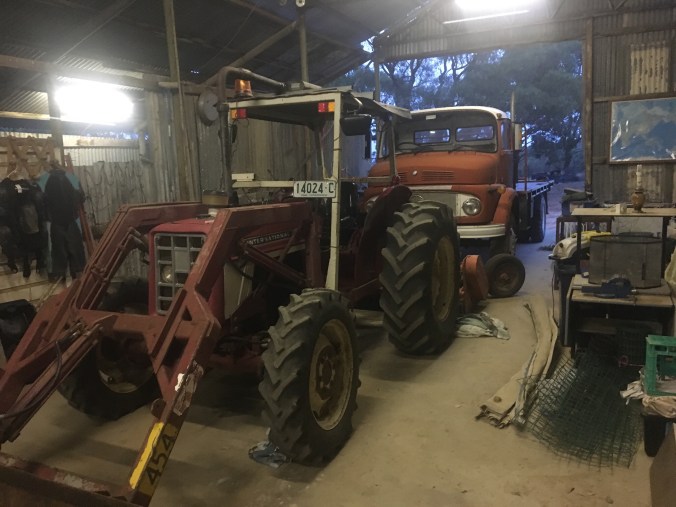
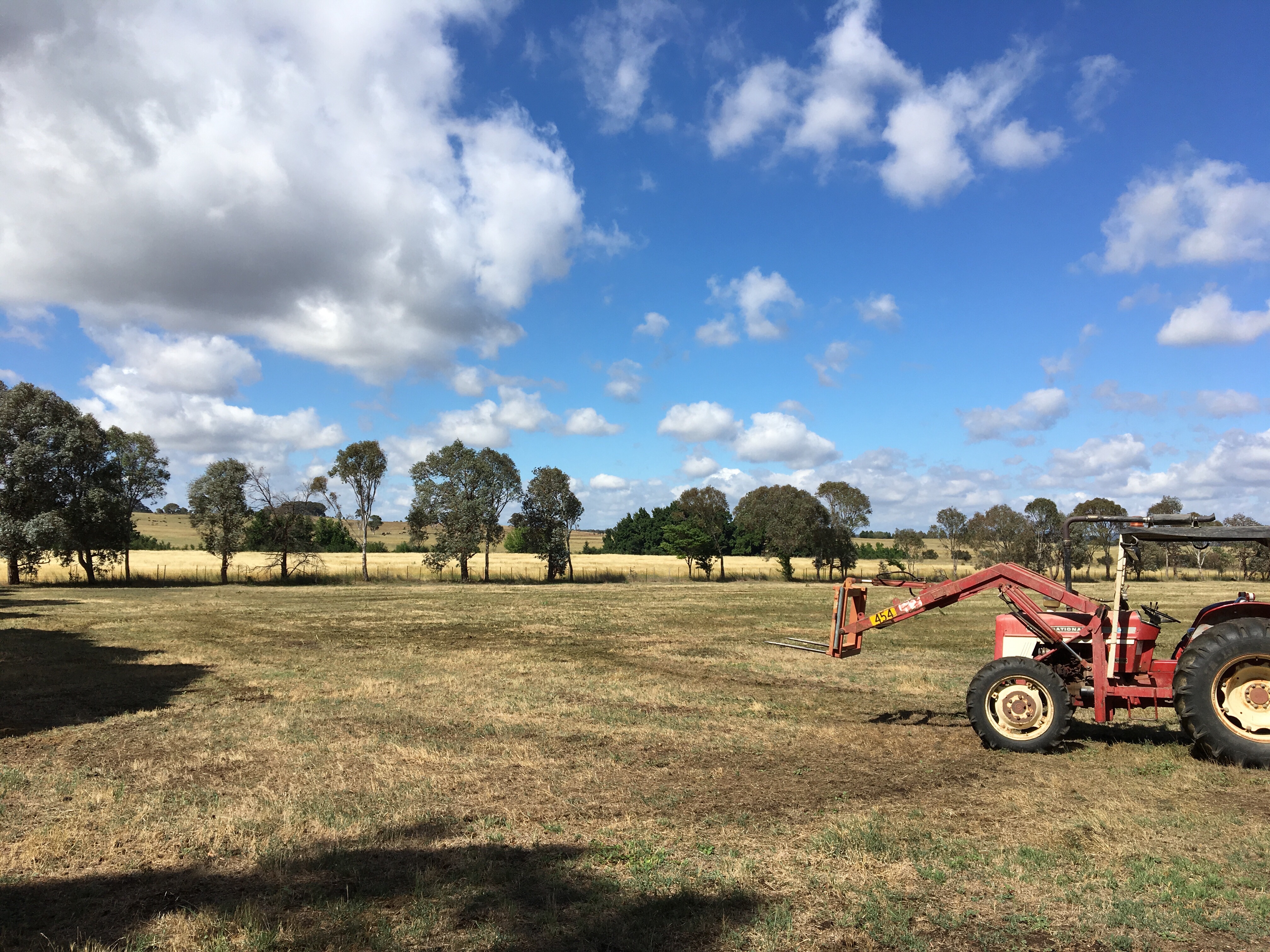
In the mean time, they are doing a fantastic job keeping the grass down whilst the tractor rests in the shed. And that isn’t a bad thing!
Soil Analysis – Results are in

Our long awaited soil analysis results came back this week.

Our samples were taken in two different areas on the farm.  The first sample was collected from our alluvial flat.  This paddock has been previously used to crop lucerne, however has been left fallow for several years.

The other sample was taken from our slopes.  This paddock has a very thin topsoil, on a base of Ordovician Shale.  This has quite a different mineral analysis, indicating that it requires different treatment.

Why is it important to have a look at the minerals present in our soil?

“You can trace every sickness, every disease, and every ailment to a mineral deficiency.”

– Dr. Linus Pauling, two-time Nobel Prize winner

This message has been reinforced by Pat Coleby, who believes that modern farming with its huge chemical inputs is not only unsustainable, but it intrinsically damages soils heath. If your soil is unhealthy, animals will be unable to access the minerals in it, and they will get sick.

img_2447

The Results:

Now the trick is for us to work out what we need to do.

And this is where it gets really difficult.  I am open to all ideas.  Please have a look at the results in the attached pdf document and let me know what you think.  Page 1 is the alluvial flat, and Page 2 is the shale slope.

Soil Test Results Apr 18.pdf

The good news is there are plenty of options available to us.

1. Lime / Dolomite

In Europe, animals were traditionally yarded over winter, and their manure spread as fertilizer in spring.  In autumn, lime was spread to maintain the soil balance, and to release the phosphorous.

In Australia, with milder winters, stock are grazed year round.  Artificial phosphorus as in superphosphate is commonly used as a fertilizer, in lieu of animal manure.  A long history of using superphosphate, without addressing the calcium or magnesium balance through lime or dolomite,  locks up a large range of minerals, rending them unavailable to livestock.

I think the quickest course of action on our slopes will be to spread lime (Calcium Carbonate) or dolomite (Calcium and Magnesium Carbonate).  This will help address the release the phosphorus. It will also increase the pH of the soil, and this will allow other trace elements to be available to the livestock.

2. Aerate the soil

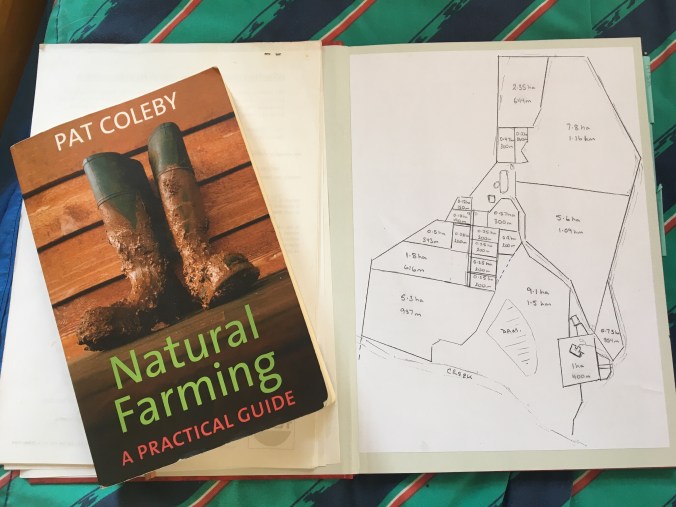
Pat Coleby  has said that “an aerator is one of the most valuable aids to soil regeneration that we have” (Natural Farming, Pat Coleby).  One way to do this is by using a Yeoman’s plow or Wallace aerator to aerate the soil.  This will allow rainfall to penetrate into the sub-soil.  P.A. Yeomans developed what we now call the Keyline System which places great emphasis “on the creation of a soil environment that rapidly accelerates soil biological activity”

http://yeomansplow.com.au/8-yeomans-keyline-systems-explained/ 

Properties that have followed the Yeoman’s principles have been more drought resilient, and have eliminated soil erosion.  The name Keyline was given to a particular contour that is found in all headwater valleys. This provides the basis for farm layout or design, in our case we will have to work within existing infrastructure to make it work for us.

Interestingly as an aside, healthy soil should absorb the first 80% of rainfall.  One wonders if part of the reason we get such devastating floods is because our soil is compacted and hydrophobic.

3. Grazing Management

Another technique we can use to improve our soil is through our grazing management.  If paddocks are intensively grazed for a short period of time, and then rested for a much longer period, many benefits can be observed.  We hope to implement a form of cell grazing on the Rock Farm, pioneered by André Voisin  in France, and further developed by Allan Savory after observing the effect of migrating animals on the grasslands of Africa.

When a paddock is heavily grazed, several things happen.  The top soil is disturbed by the action of the stock’s hooves or feet.  The tall grasses are eaten, and long roots of the plants retreat.  The animal’s manure releases much of the nutrients held in the grasses back to the soil.

When the paddock is rested, the seed bank that is in the soil is activated, encouraging new growth in the disturbed soil.  As the long grass roots retreat, they provide access for water and air to penetrate the soil and avenues for earthworms to pass through the soil.  Dung beetles and earth worms process the manure, turning it into a valuable fertilizer for the soil.

Whilst optimum rates for stocking are around 60 head of cattle per hectare or 450 sheep per hectare during the intensive grazing period, a long rest period of 6-12 months mean the overall stocking rate is much lower.  This will also require a much greater investment in fencing, however with the benefit of several small paddocks on the Rock Farm, we should be able to utilise parts of this technique.

4.  Planting Trees

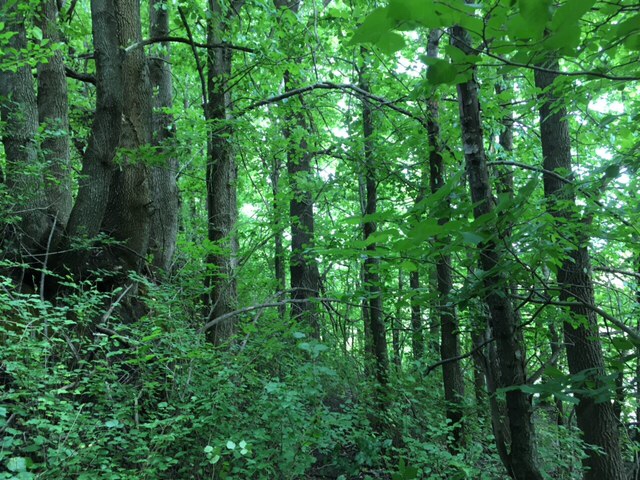
Trees – importantly the right trees – can help remineralise soil.  The most effective trees are deciduous, as they draw minerals from deep in the ground and return them to the soil as their leaves mulch after falling to the ground.  Deciduous trees can also help reduce the fire risk to a property.  Our property has some magnificent old Elm trees, with glorious lush green grass growing underneath them.  Unfortunately our trees are English Elms, which tend to sucker, and in a couple of places have formed dense thickets.  Scottish Elms are just as beautiful and don’t sucker.

img_1978


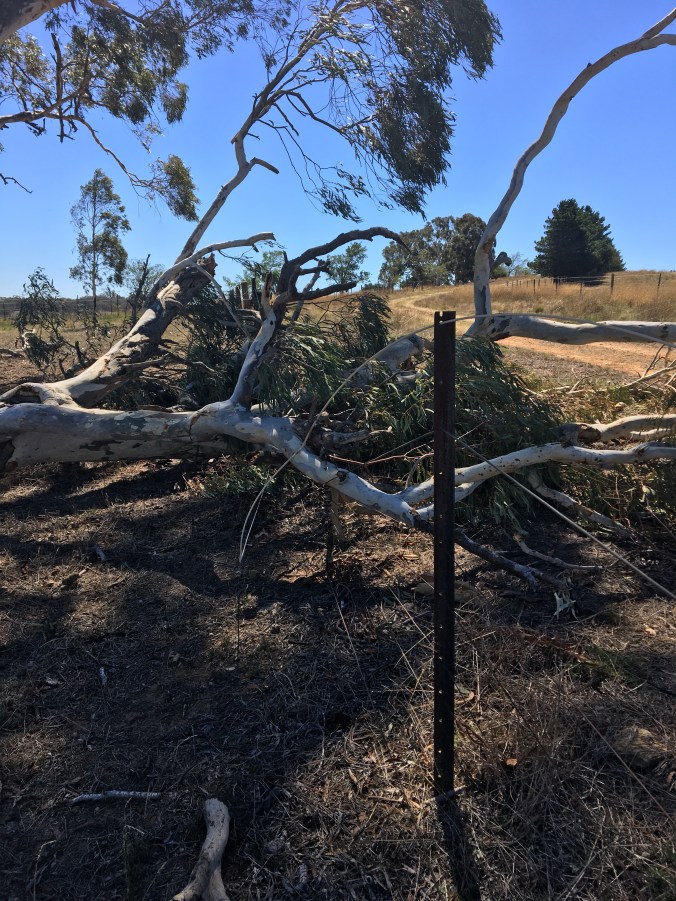
Eucalyptus trees are important habitat for native birds and have their place too, however they tend to draw moisture and minerals from the surrounding soil.  They also have a nasty habit of dropping branches, especially on fences!

img_2535

We will continue to plant trees on the Rock Farm.  It is an extremely satisfying activity and we hope that one of our legacies will be the trees that will continue to grow for future generations.

img_2561

Research, Research, Research

In the meantime I will continue to research what is the best possible outcome for our property with respect to its mineral requirements.  I acknowledge that I am extremely fortunate in that my main objective is in learning as much as I can, without the burden of trying to support my family with my farming enterprise.

If anyone has any more ideas on how to increase the soil fertility on the Rock Farm, or has any insights into our soil analysis, I would gratefully accept your views in the comment section below.


Happenings at the Rock Farm

I must admit I consider myself extremely fortunate to have the opportunity to share our beautiful property with my family.  One of my favourite times is when we get together as a family and do a bit of work on the Rock Farm.  It helps my kids understand a bit more about the joys and responsibilities of property ownership. As a bonus we get to spend some wonderful times together, and the recent school holidays allowed us to do exactly that.

Our first order of business was to replace a very tired (rotten) post, rail and wire fence.  The old timbers didn’t take much effort to push over, having all rotted off at the bases.  A new ring lock wire fence was soon strung between the existing strainer posts and our fence was again in sound order.  The added bonus was the old posts were nicely seasoned, so were promptly carted off to the firewood pile.  The only catch was they were full of nails and staples, requiring careful extraction before being cut into fire-sized pieces.

This load was also a good test for the new ‘wheelbarrow’ having recently replaced our almost indestructible (but obviously not) Mitsubishi Mirage.  The ‘new wheels’ are already earning their keep as a load hauler / work platform and ferry.

Jo managed to complete the first new portable chook-tractor.  This will form the basis for our new circular vegetable beds.  A relatively simple design, it is lightweight and easy to move.  The plan is for the chooks to do the hard work weeding and turning over the soil, before we then move them onto the next patch and plant vegetables.  We might have missed most of this growing season, but we are looking forward to establishing some vegetables soon.

We moved the sheep to greener pastures (paddock rotation).  During this process we found that sadly one of ewes had been killed by foxes, and another of our lambs was badly injured during the same attack.  We had to put the lamb down.  Thankfully the rest of the sheep were in good health, and after a few days ‘mowing’ our shed paddock, they were released back to the larger paddocks.

I also finally got around to installing a new weather station.  With Jo’s trade being a Meteorologist, having a good weather station has been high on her list of priorities for a while.  The challenge has been finding a place sufficiently close to the house that the signal will reach, whilst being far enough away to not be influenced by the house structure, trees or shed.  We settled on a compromise, but I had to fabricate a new post out of some old steel off-cuts to ensure the weather station is out of horse or cattle reach!  Time will tell if it is high enough!

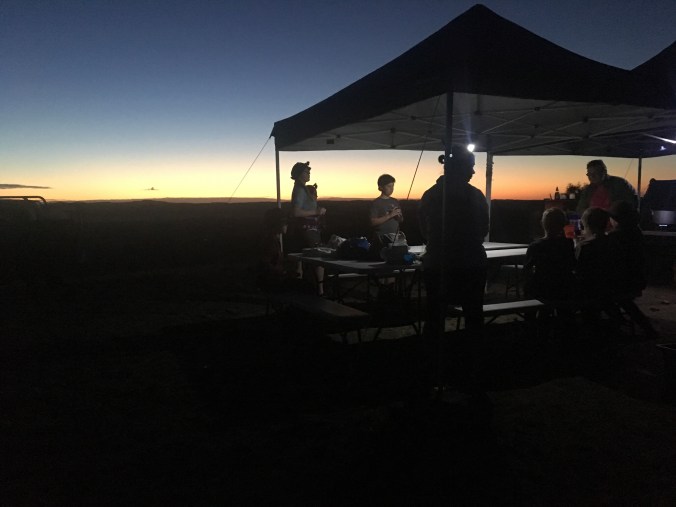
It was also school holidays.  This meant that a good part of our time was spent doing the real important things you should do, as a family.  We decided that we would enjoy our very own ‘stay-cation’, and set up our swags on our neighbour’s big hill.  In fact it worked far better than I dared hope. We managed to get a good day’s work done on the farm, and after a quick shower in the house, we headed to the top of the world to enjoy dinner and a couple of drinks as the sun set.

Camping in our own back yard allowed us all to achieve something on the place, whether it be on the farm, in the garden, around the house or just chillax.  Importantly we also got to enjoy a couple of nights under the stars – as a family.  I can tell you it was priceless.

The cycle of trees


We have enjoyed a busy few weeks on the Rock Farm, and we are now also starting to make some changes for the future.  Up until now, we have been largely focused on repairing existing infrastructure.  There is still plenty of work to do in this space, but we are also fast approaching autumn and the best time to plant trees.  But just as we were getting ready to plant some trees, the weather turned for the worse.

The Rock Farm was subject to a couple of days of bracing winds.  Whilst there was quite a bit of damage sustained in the region, we thankfully escaped with only a couple of branches and trees down.

One particularly fortunate group was the local scout troop that had camped on the Rock Farm.  They managed to strike all their tents before the forecast wind came, however one gazebo was destroyed before they could get all their equipment stowed.

A few sheets of iron on the shed roof needed to be screwed back on tightly, but the main job after the wind had stopped was to clear downed branches off fences.

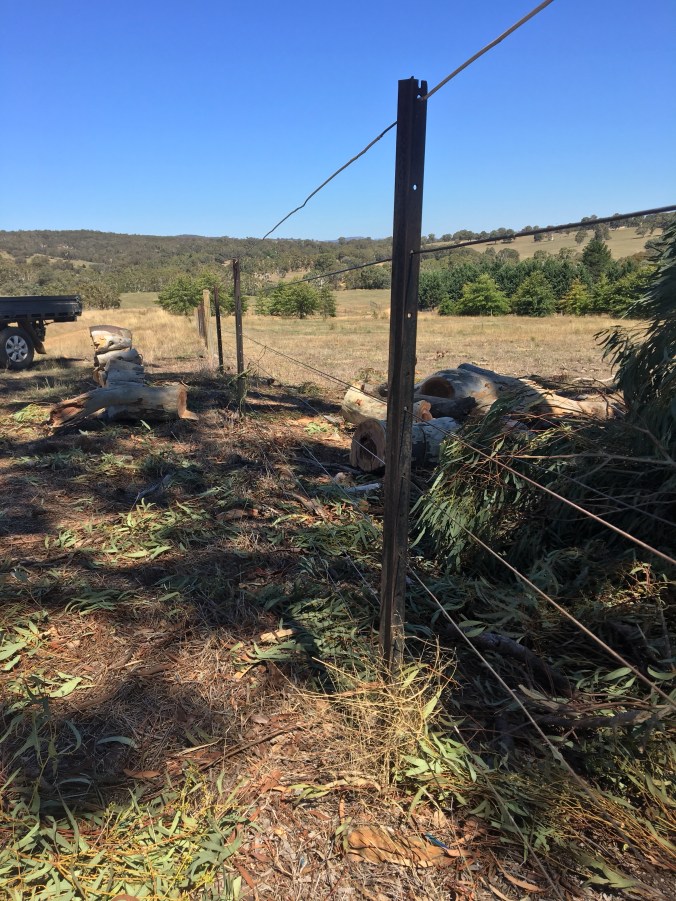
It didn’t take too long to clear the timber off the fence.  The leafy branches were left in paddock to mulch under the tree, and the larger pieces cut for future firewood.  The bent star-picket was re-straightened and the broken wires repaired.  The plain wire was relatively easy to tension and soon the fence was looking no worse for its encounter with the Brittle Gum (eucalyptus mannifera) branch

img_2536

After the wind, and with the promise of rain, we decided to make the most of the opportunity to plant some trees.  One of our favourite trees is the Bunya Pine Araucaria Bidwillii.  This native pine is found naturally in south-east Queensland, however there are some fine specimens in our local area, some reportedly pre-dating European settlement suggesting they were planted by Indigenous people.  The trees are a popular choice for bush food gardens, provided you have the space to grow them.

It is easy to understand why.  The Indigenous people would celebrate the ripening of the fruit with ceremonies, celebrations and feasts.  Groups of people would travel for hundreds of kilometres to attend,  making the most of these opportunities to trade, negotiate with other groups and marry.

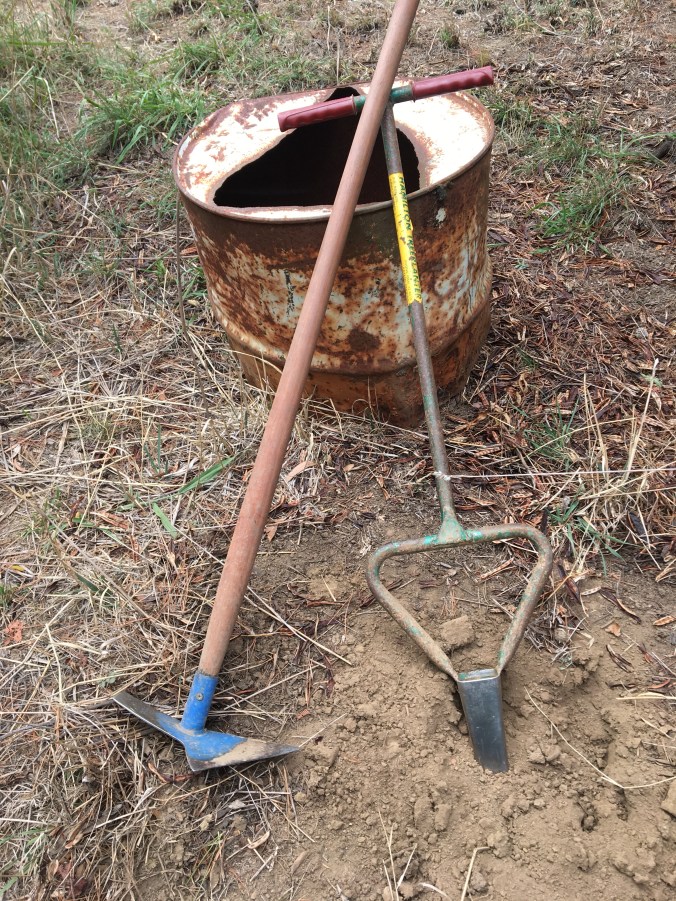
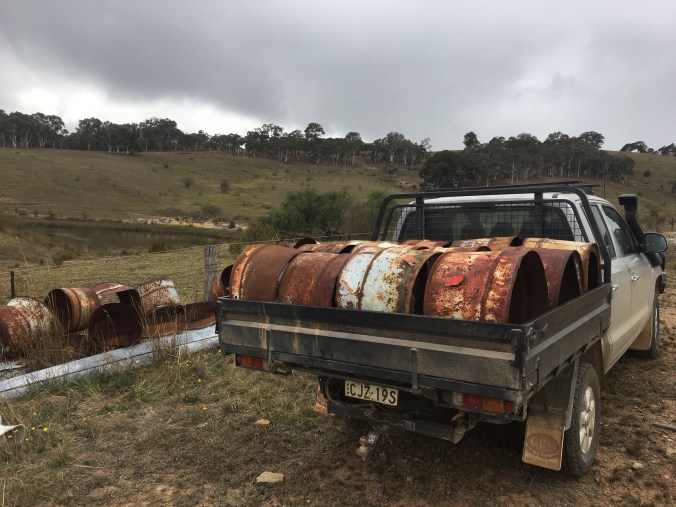
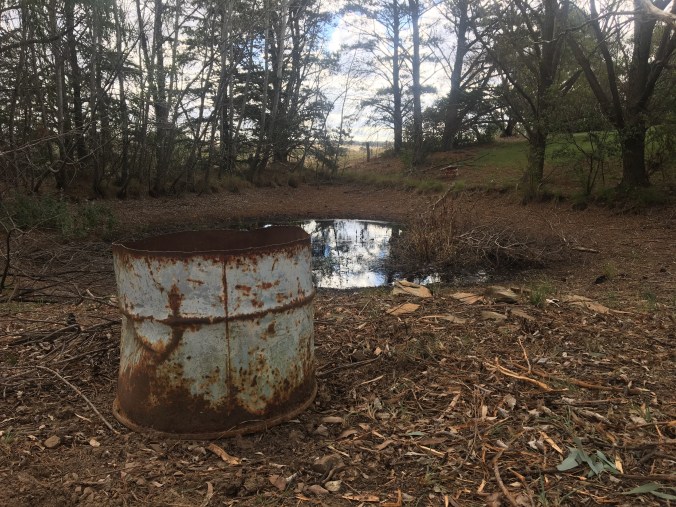
Our aim is far more simple.  We would like to see some of these trees grow on our property.  Our first job was to collect some old 44 gallon drums that would form tree guards and protect the young trees from rabbits.  Every farm has a ‘resource centre’ and we just had a wonderful collection of old half 44 gallon drums that had the base cut out.

We have decided to see if the trees grow naturally.  We prepared the sites by scraping off the grass and weeds, and loosening up the soil with the Hamilton Tree-Planter.  We put three seeds in each drum tree guard, and then placed a layer of natural mulch on top of the seeds.

Some of the drums were placed in open areas in paddocks, others were placed in sheltered areas with plenty of trees providing shade.  Once we see how the trees go, we will be able to plant more of these trees.   We aren’t in a rush.  Trials suggest that about half of the viable seed will germinate in around six to nine months… but for a tree that lives around 500 years, I figure we can give it a while to get going!
It will be great to see how they go!
The rain comes!

Things had been getting a little grim on the not-so-rocky Rock Farm.  The end of summer was approaching, but the rain gauge had been dry for weeks.  Even the most hardy plants were starting to look stressed, and neighbours were starting to plan to feed their stock.  On the domestic front, things were as busy as ever, with the Little Fisherman starting high school, and the Little Helper settling into year 6.  In the midst of all the chaos, I went to sea for a couple of weeks.

It was no better when I got home.  In my absence, both cars had broken down, the boys had been home from school sick and the sheep had disappeared (only to return the next day from their holiday).

But then we got a beautiful 50mm of rain and everything changed.

My list of jobs I want to do on the Rock Farm is rather long.  Everything requires an investment of time or dollars or both and many require the right weather.  One of the many on the list was to smooth the corrugations out of the driveway – but had been too dry to even contemplate, until it rained.

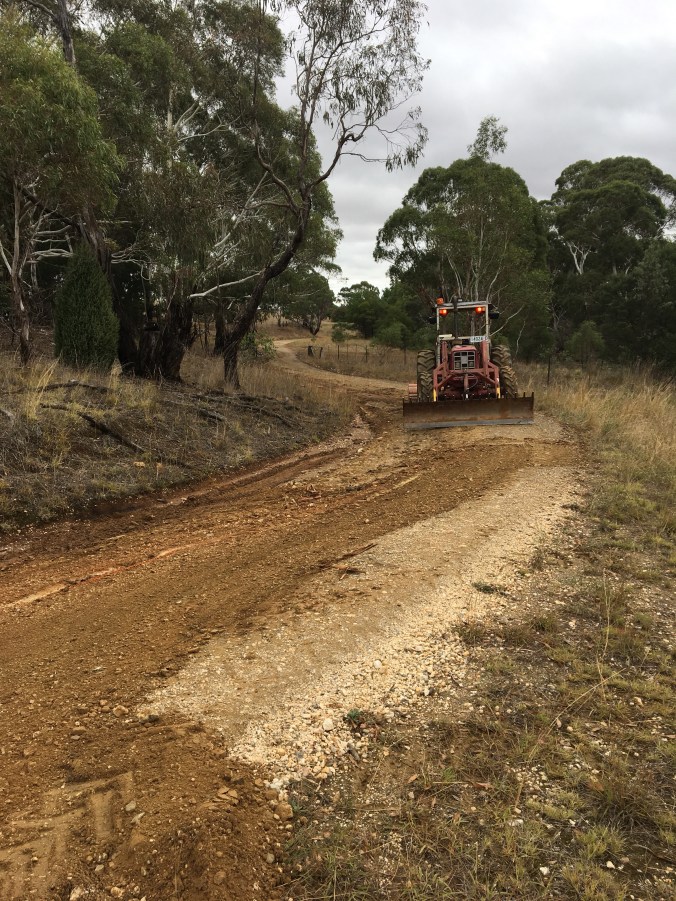
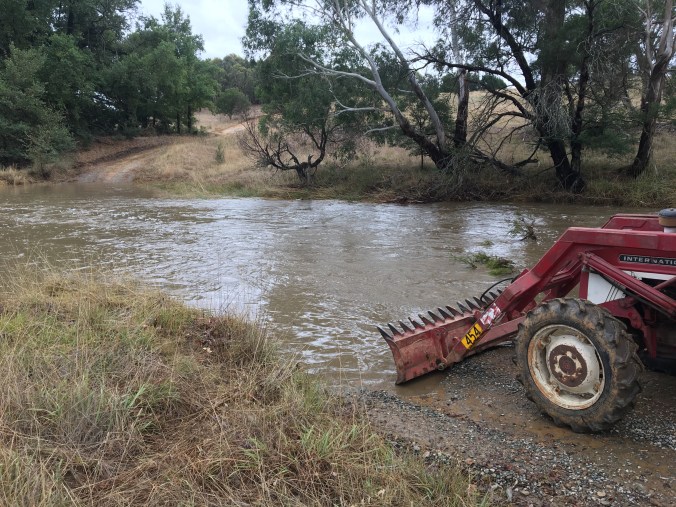
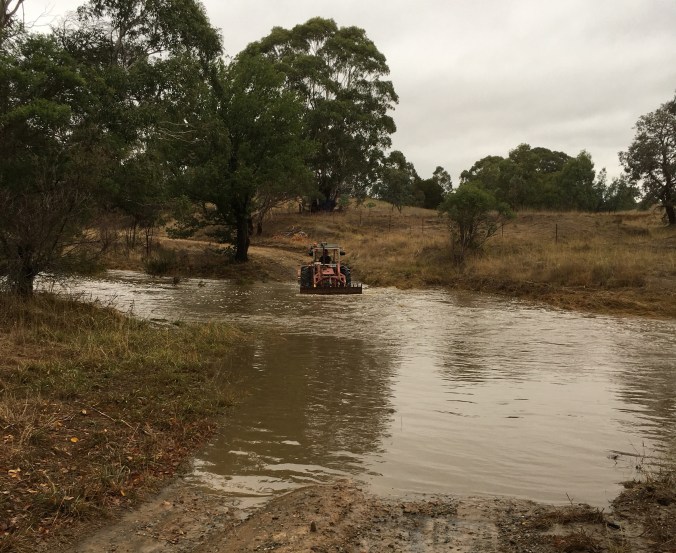
When the rain fell, one of the first things I wanted to do was to run a blade over the driveway.  All went well, until I made my way back towards the house…  The creek crossing that had been dry little more than an hour earlier was now impassable.

Thankfully it was dropping just as quickly as it came up.  Soon our depth gauge (a well calibrated star picket) was visible, meaning it was safe to take a 4wd across.

Creek Crossing

That little saga over, I would have liked to continue working through some more of the jobs on my list, but it wasn’t to be.  I had another week away starting early the following morning, but this time I had some down time.  It was the perfect opportunity to re-read one of the most influential books on farming I have read, and do a bit of planning.

Pat Coleby is one of Australia’s foremost experts on farming without chemicals.  Her work is visionary on one level, however when you think about what she has to say, it really is common sense.  She shows how the key to healthy plants and animals is healthy soil.  Her book is full of practical advice on how to improve the soil, and she guides our approach to our farm.  If you’re going to buy one book for your farm, this is a great one!

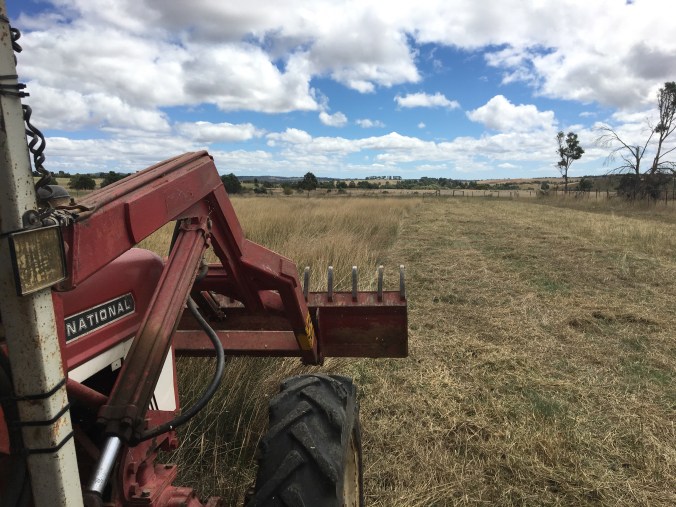
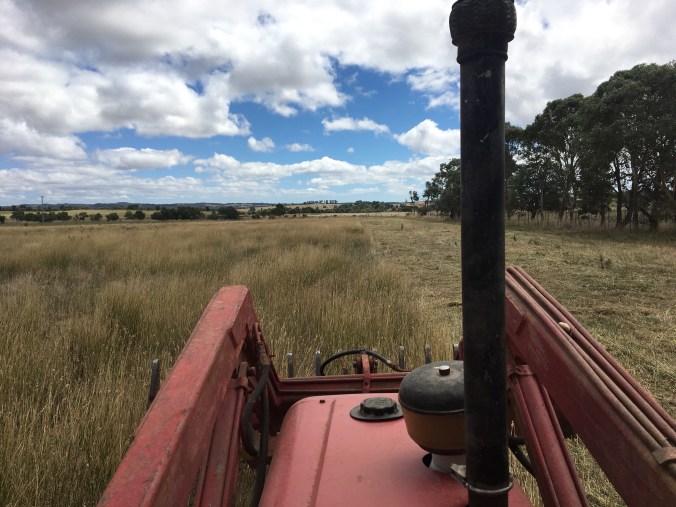
Part of what we need to do is to return organic matter to the soil.  Slashing the long grass helps to achieve this.  It also causes the grass roots to reduce in size, creating tiny holes which aerate the soil and provide opportunities for earthworms to work through the soil.  I hope to get some cattle to help with this process – as they return the organic matter to the soil in the form of manure.  In the meantime, the old tractor was able to slash this 5 hectare paddock in around 2.5hrs.

One thing I will arrange in the next week or so will be soil tests.  These will help us to identify shortcomings in our soil health.  With the application of the correct amounts of calcium, magnesium and sulphur, we should get our soil back in balance.  Once the soil is in balance, we should see an improvement availability of trace minerals and an increase in activity in soil by the micro-oraganisms and earthworms that drive soil fertility.  This should lead to a reduction in weeds, and an increase in a variety of species that provide minerals and trace elements to our stock.

It is a journey, and I am looking forward to learning about soil chemistry and biology in our quest to improve the health of our land.


Some lessons you can’t learn at school

The last week or so of the school holidays finished with a flurry of activity – but not all of it was on the Rock Farm.  A few nights in Sydney provided a change of scenery – of sorts.  I was struck looking out of our hotel window in Pyrmont that the environment around us was almost completely manufactured.  The only greenery visible was a small hedge by a pool down below, and the top of a couple of trees just visible above the street.  The hum of traffic and ventilation fans provided a constant white noise reminder that the city environment is far removed from the peace and quiet of the Rock Farm.

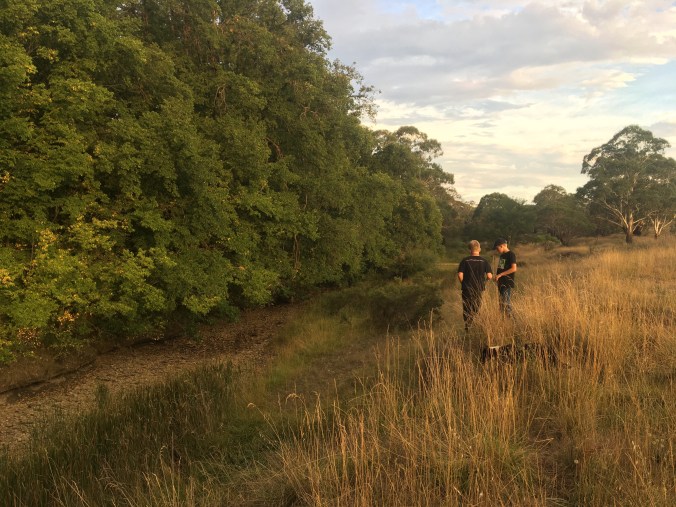
I couldn’t wait to get home and breathe the fresh country air, where the hum of the city is replaced by the chatter of birds in the garden.    And I think we all felt the same – because it didn’t take much to encourage the kids to join us for a walk down by the creek to recharge our souls when we got home.

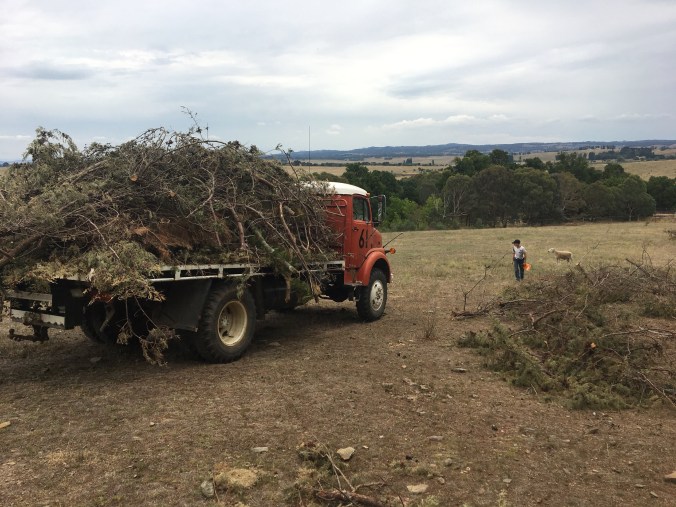
There were a few little jobs I wanted to get on with, none particularly onerous.  The first was tidying up some of the trimmings along the fence I had repaired a couple of weeks earlier.  Myrtle was pressed into service and the old truck allowed me to move the large volume of branches from where they lay to some bare soil with a minimum of fuss.

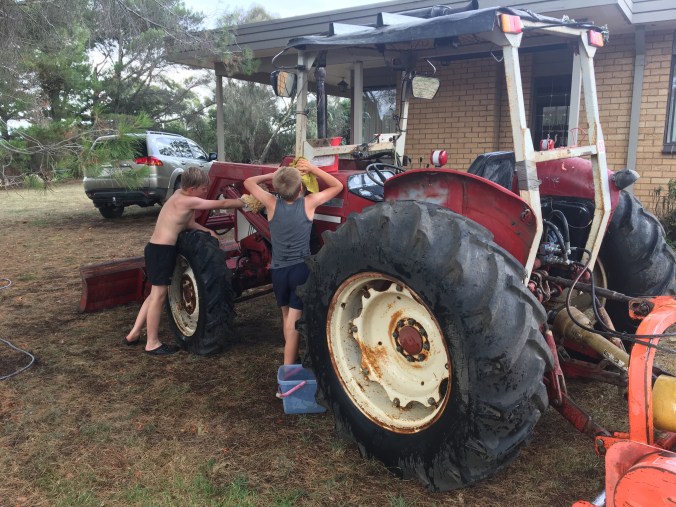
Lucie the tractor was due a oil and filter change.  The Little Helpers gave the old girl a good wash – not because I like it shiny, but I find it a good opportunity to check over the tractor and identify any loose or missing bits.  Somewhere under the dust and grime we identified the key components of the engine – especially the fuel filters, which I was going to change in a couple of days.

The Little Helpers did a great job – even cleaning the mirrors!

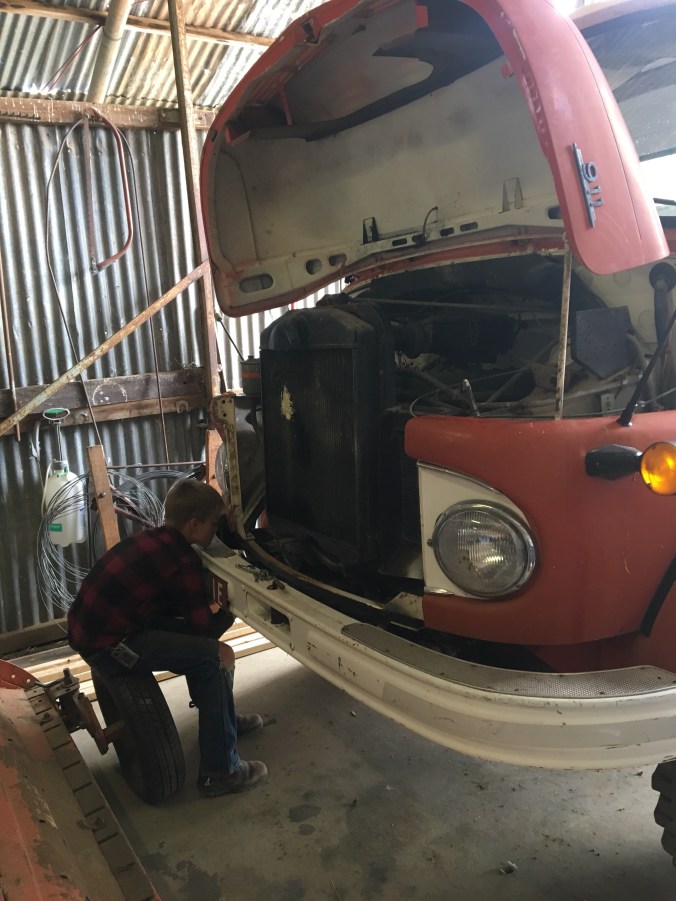
Andrew, a local expert came out and helped me change the fuel filters on both the truck and the tractor.  I’m very glad he did, as the fuel filters on the tractor proved particularly troublesome to reseal.  We also replaced the broken hand throttle cable on the truck.  This cable not only adjusts the idle speed of the truck, but also allows you to shut down the engine.  Until now I had been stalling the engine to force it to stop.

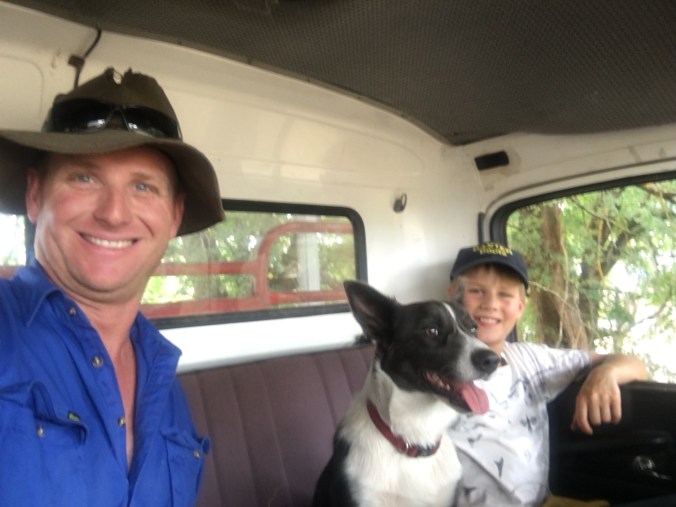
The Little Fisherman learnt a lot of new skills – all simple stuff, but important.  His funniest observation came when he found an unused plug on the wiring loom.  He asked me if that was where you plugged in the computer to tune the engine!   I can understand why he thought that – every car we have had since he was born has had a diagnostic port… so it is only logical that you’d assume you tune trucks the same way.  I told him that this old girl was tuned the old fashioned way, mechanically, and come the zombie apocalypse, this truck would spirit us to safety!

One of the things I really appreciate on the new Rock Farm is a large shed that I can use to work on the vehicles.  It might not be heated, but it is really nice to be out of the weather, and the concrete slab helps.  It might not be pretty, and sure isn’t tidy, but we can work on that.


Of course the best part of any service is the test drive!  It was pleasing to note that both Myrtle the Mercedes and Lucie the Tractor both performed flawlessly.  There is nothing like turning diesel into noise…

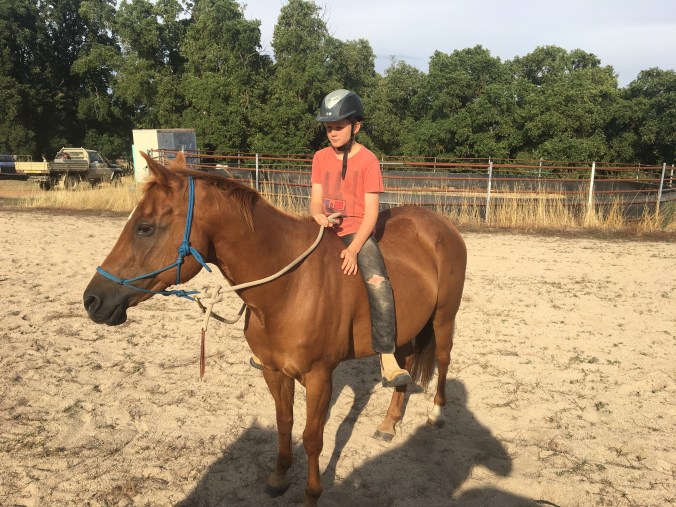
But then again, there is somethings special about horses that horsepower can’t match! This beautiful fellow is like that breath of fresh air – good for recharging the soul.  The Little Helper and I also enjoyed chillaxing with our four legged friends.

Thinking back to our time in Sydney just a few days earlier, I was reminded of the immortal words of Clancy of the Overflow, written by Banjo Patterson back in 1889.  In that poem, a city-dweller longs to swap with Clancy, a shearer and drover.  Banjo romantically describes the differences between the city and the rural landscapes and often as I leave the city for home, his words come to me.

And the bush hath friends to meet him, and their kindly voices greet him
In the murmur of the breezes and the river on its bars,
And he sees the vision splendid of the sunlit plains extended,
And at night the wond’rous glory of the everlasting stars.


Tree of Heaven removal on the Rock Farm

The other day I wrote about some of the weeds of significance we have on our property.  Tree-of-Heaven (Ailanthus altissima) was one weed that we had identified using the excellent Weedwise app and I decided it was to be the first on my hit list.

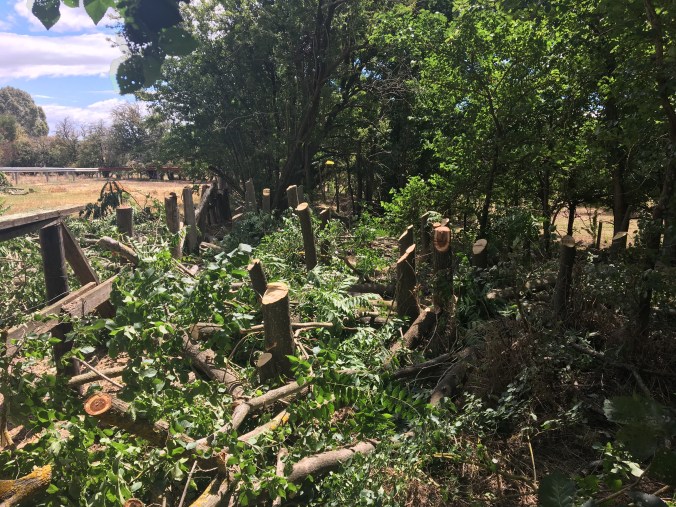
I thought we had one tree and a handful of suckers.  My initial assessment was wrong.  Very wrong.  I found we had a thicket of around 40 trees, between 4 and 6 metres tall, in a nook between an old timber and wire fenced horse paddock and the boundary.

Tree-of-Heaven is a deciduous tree.  It forms dense clumps or thickets from suckers which spread from its roots.  These clumps out compete other more desirable plants.  It is a major weed in North America where it is choking natural woodlands.  Once established, it is very hard to get rid of.

I decided the best approach was to first mechanically remove the trees and slash or dig out the suckers.  Then any future growth would be small suckers that I will be able to spot spray to kill the plant.  The first step was to drop the trees.

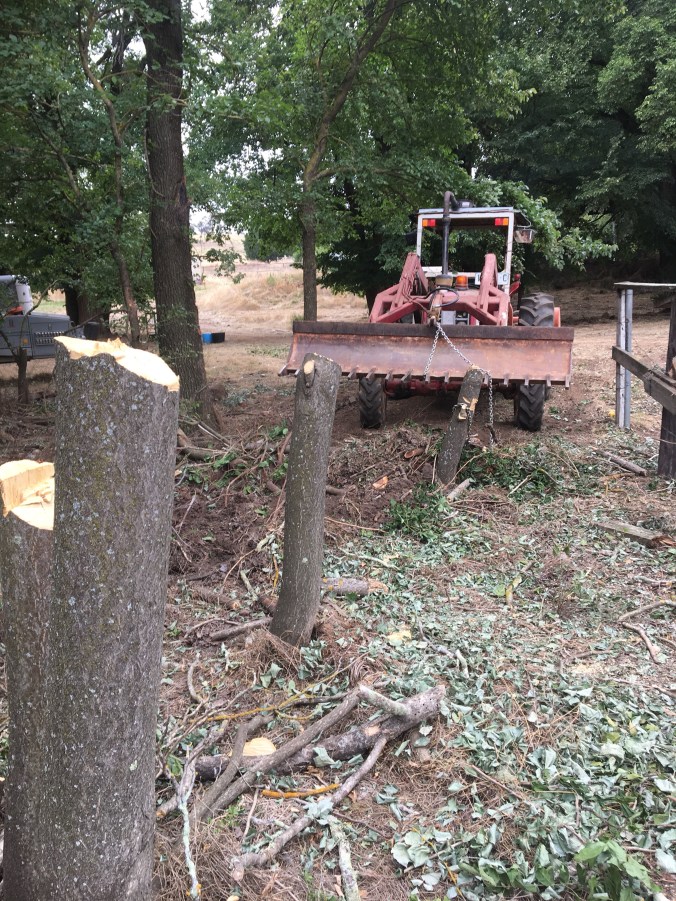
Thankfully the timber is very soft and light, and the chainsaw made short work of dropping the trees.  The old timber fence was abutting up next to the thicket, but as it was already in need of replacing,  I ended up felling a few trees onto the fence.  This made it easier and safer to fell the trees, and allowed me to protect some of the other trees growing in the vicinity.

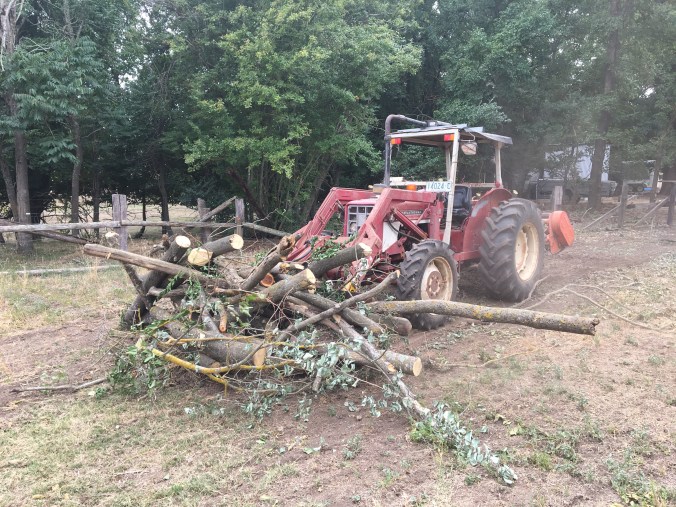
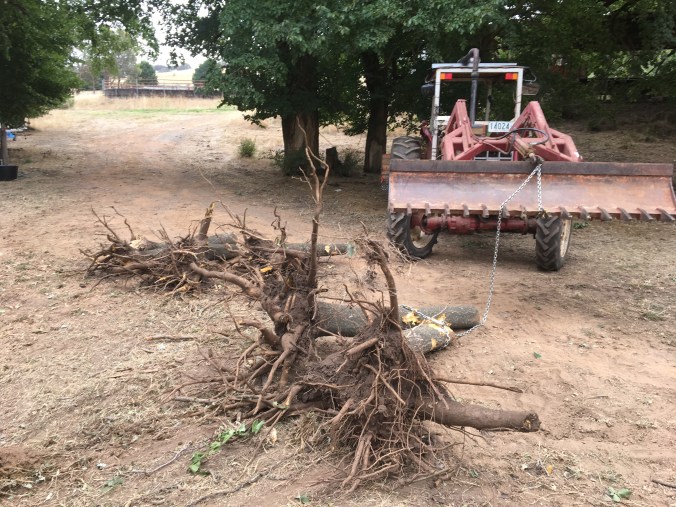
The result was small mountains of branches and logs.  Without an army of helpers to move the logs, I put the stick rake / blade onto Lucie the old International 674 tractor, and set to work.  Lucie unleashed all 61 horses (perhaps a few have escaped the stable in the intervening years) and pushed the logs into a couple of large piles.  It sure beat man-handling the logs.

The next step was to remove the stumps.  I had deliberately left them quite tall, to allow me extra purchase when pulling them out.  If I had the room, I would have pushed them all over, but as this encroached on the neighbour’s place, I had to pull most of them out.  A recovery chain proved most effective.  Before I bought the tractor, I used to use the 4WD to pull out stumps, but the tractor with its low gearing, agricultural tyres and 4WD allowed me to pull them out in a far more civilised manner.

The war against weeds is far from over, but we have taken a few steps in the right direction.

Lucie is proving her worth as a reliable and hardworking spare hand.  After we had pulled out the weeds, I treated her to a change of oil and some fresh grease on the moving parts.  Over the next few days I hope to change the fuel and air filters too.  Then she will be good to go for another hundred hours or so.

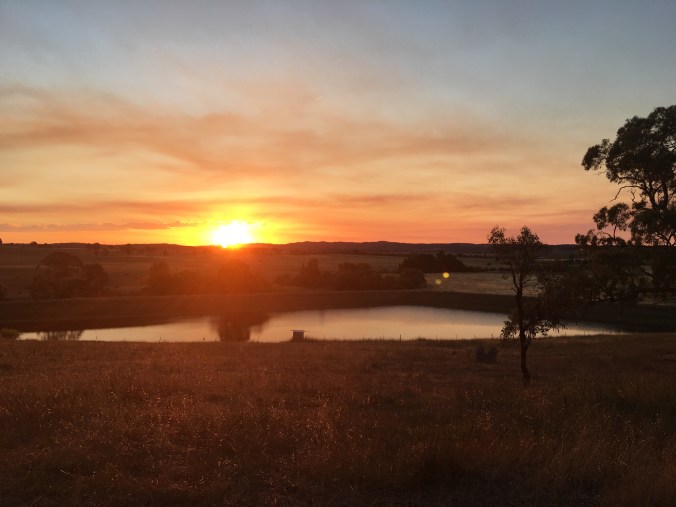
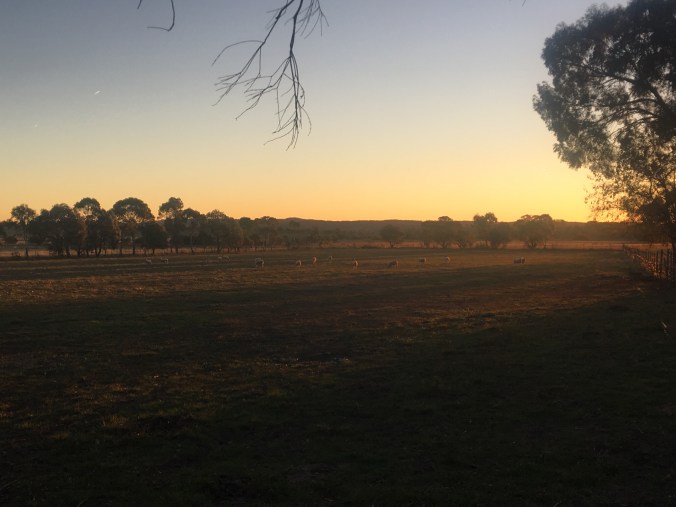
In the meantime, it is nice to sit back and relax.  Moving out to a hobby farm isn’t for everyone, but you might have figured I love it out here.  Especially when you get to take a few moments to enjoy a sunset that makes all the hard work worth it.

Fencing and moving sheep

The new Rock Farm was set up originally to spell race horses.  As such its paddocks were all made with plain wire.  Later cattle were run on the property, and an electric wire or hot wire was installed.  Sadly running sheep wasn’t a concern, and we found very quickly that we would need to work on improving the fences quickly in order to rotate the sheep through the paddocks on the farm.

I have decided that the best thing I can do it work on a paddock at a time, and concentrate on making it stock proof.  I chose a 5.6 hectare paddock, that despite its small size has over 1 kilometre of fencing around its perimeter.   The first thing to do was remove the branches that had fallen on or were about to fall on the wires.

Ideally I will install a stock mesh on the fences, but for now the cheapest and easiest solution was to fix up the existing plain wire fences.

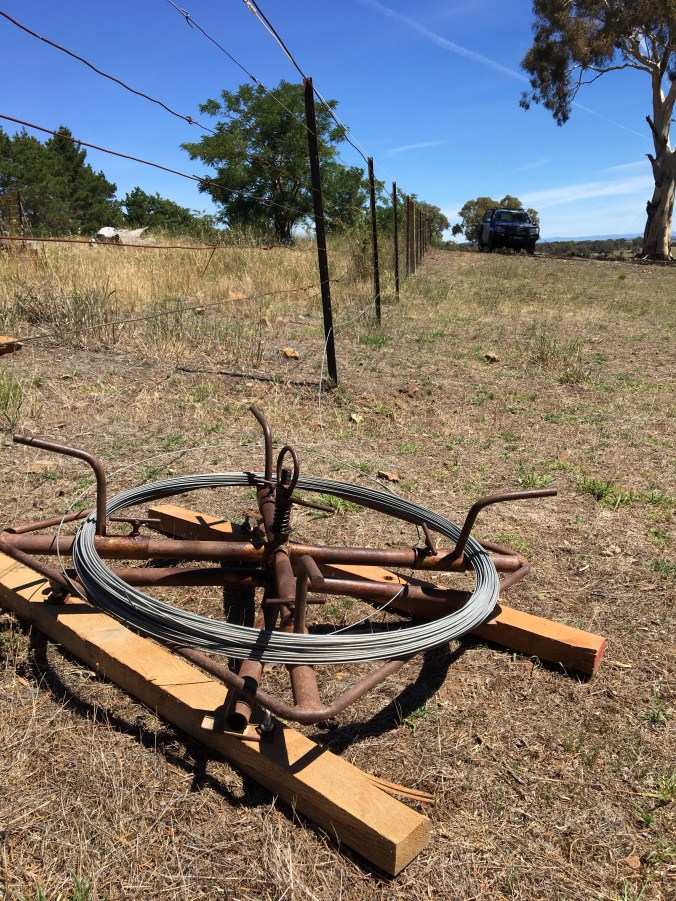
On some sections of fence I had to install a bottom wire through the bottom hole of the star picket.  This wire in most fences would  be at ground level, however these pickets are barely in the ground.  Every fourth post is a concrete post that has been dug into the ground, providing most of the stability required.  The wire spinner is invaluable when it comes to running out wire on your own.  We found this old one behind the shed and after replacing the timbers and a few days soaking in WD40 it was restored to normal operation.

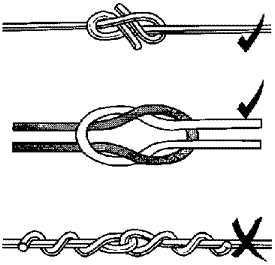
In other sections of the fence, the bottom wire was broken.  This required me to join wires and strain the sections.  One of the best knots for joining wire is called the ‘Figure of 8’, for obvious reasons.  For some reason, I found it difficult to make, having to really think through it every time I made it.  It is a great knot as it doesn’t reduce the wire’s strength.  Thankfully I got better as the day went on.

Image result for figure of 8 fencing knot

Edit – The image above shows the correct figure 8 knot… it seems I didn’t get it right after all….

Source:   https://www.kencove.com/fence/100_Fence+Construction_resource.php

img_2210

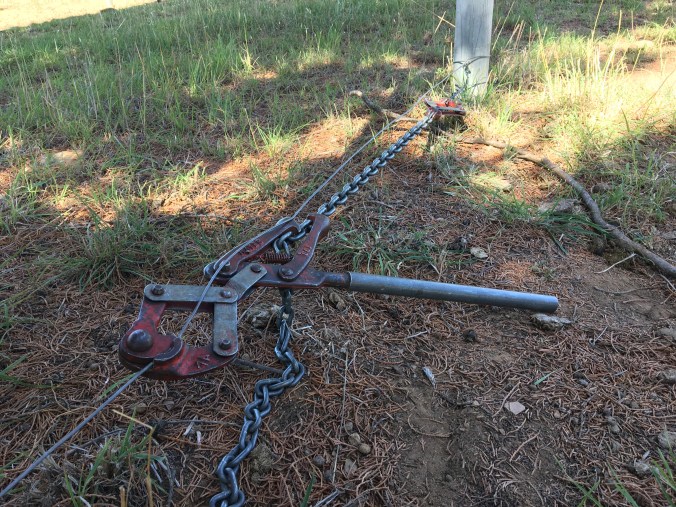
To strain the wire tight I used an old set of Hayes wire strainers.  The design of these strainers hasn’t changed in over 100 years.  They are simple, reliable and need very little maintenance.  The amount of purchase you can achieve with these strainers is immense, and once you have the technique, they are incredibly versatile.  I went around the paddock, straining the bottom two wires, which are the ones the sheep will put the most pressure on.

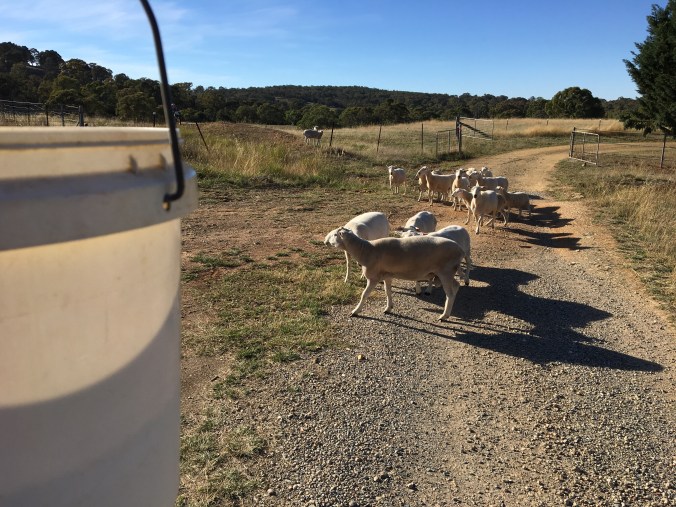
And then it was a simple case of bringing the sheep in.  A nice bucket of fresh oats, and a few loud “C’m’on” they came running… well almost.

Seventeen of Nineteen sheep followed me excitedly to the new paddock.

One ewe and her lamb eyed the open gate with suspicion and disappeared back into the paddock.  I have had a run in with this ewe before – she was particularly difficult to muster when we moved here.  In case of such an eventuality I had the boys ready on their four stroke steeds, and I thought they would have her rounded up in no time.

I was wrong.  For the next hour and a half all the whole family was pressed into service to try and push her out of her paddock.  And she refused.  Just as I was on the point of finding a very permanent solution for her lack of motivation, she must have read my thoughts.  She trotted through the gate calmly as you like, and continued up the lane and into the new paddock.

By then it was already well past 30 degrees, and the forecast for the following day was going to be just shy of 40 degrees.  We decided that the Rock Farm could do without us for a day, and decided to take the next day off and make a dash to the coast.

As much fun as swimming in the dam on the Rock Farm is, it doesn’t beat the salt water waves of the coast.  Sometimes you just gotta take a road trip!

Some more on weeds

It has been a hot few days on the new Rock Farm.   I will talk about our fire-plan in the near future, but in the mean time I have been researching some of the weeds that I have identified on the property, and developing strategies on how we will deal with them.

The best place to learn about weeds in our area is the NSW DPI (Department of Primary Industries) WeedWise website http://weeds.dpi.nsw.gov.au/.  The NSW WeedWise page is a wealth of information about what plants are listed as declared weeds in NSW, including priority weeds for different regions.

They also have a handy WeedWise App, which I have downloaded onto my pocket brain.  This means I have access to the full weed database and recommended treatment options all the time.

http://weeds.dpi.nsw.gov.au/

Managing weeds is the responsibility of the land owner.  Sadly infestations of certain weeds can render arable farmland next to useless.  It is also the source of much frustrations between neighbours particularly given the way most weeds spread with no regard to fences or boundaries.

Whilst I would love to ensure our weed management practice is chemical free, I don’t believe this will be achieved in a timely or cost effective manner.  The WeedWise site and app provide information on chemical free, mechanical and selective grazing weed removal techniques, as well as methods using chemicals.

But no matter what technique you use, the best time to start is the present!

Tree of heaven

Tree of Heaven – source http://weeds.dpi.nsw.gov.au/Weeds/Details/142

Tree of Heaven (Ailanthus Altissima) is a plant of Chinese origin that is highly invasive and quickly chokes an area.  I have found one large plant and dozens of suckers in one of the old horse holding paddocks.  Mechanical removal requires the removal of all root matter as it will readily shoot from the smallest remaining root.  This will take concerted effort to get rid of, and will be best approached with a combination of mechanical and chemical methods.

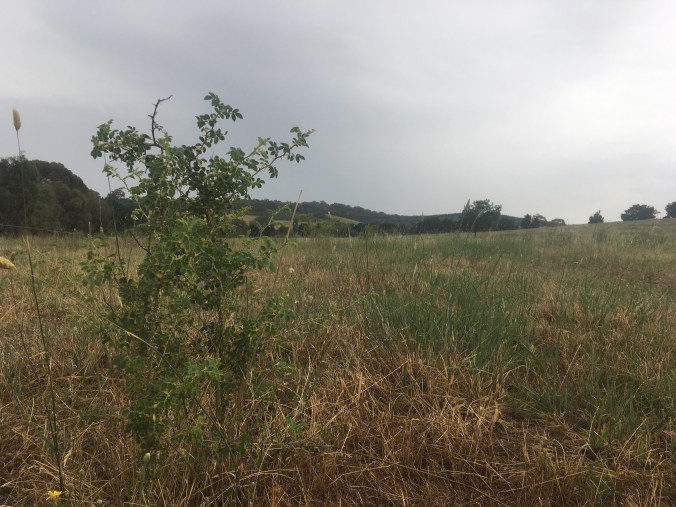
Sweet Briar – (Rosa Rubiginosa) Is common in a lot of our paddocks.  Sheep eat young plants whilst goats will defoliate and ringbark the plants, killing it.  I have slashed a number of these plants in the paddock the sheep are in, hoping that the sheep will eat the young shoots as it re-sprouts.  Apparently cattle don’t eat Sweet Briar – meaning sheep stay part of the wholistic management process for this weed.
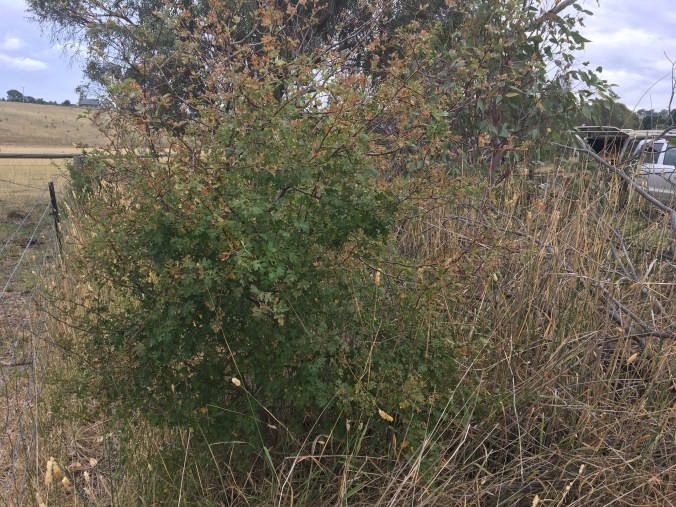
Hawthorn (Crataegus Monogyna) is also present but thankfully in only small numbers.  I will try to keep on top of the Hawthorn thickets and ensure they are mechanically slashed and see if the sheep will keep on top of the suckers.  The only catch to all this is I need to ensure my paddocks are sheep proof – and this will take additional work!
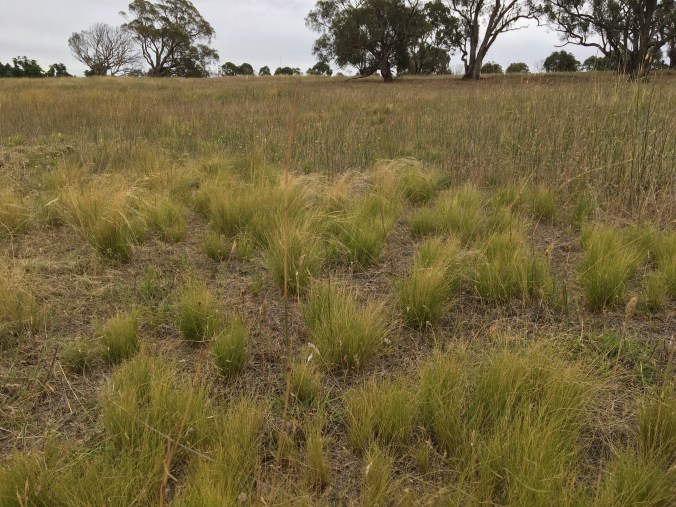
Serrated Tussock (Nassella Trichotoma) is common on our property.  It made its way to Australia during the Gold Rush of the 1850s where it was used as stuffing in saddles.  Not palatable for stock, it is most cost effectively controlled by spot spraying individual plants.  The main chemical, flupropanate can also be applied in a granular form using a device similar to a salt shaker.  The granules will activate in rain and provide a long term herbicide against re-germination of the plant, with minimal effect on other pasture, or it can be sprayed in a solution form.
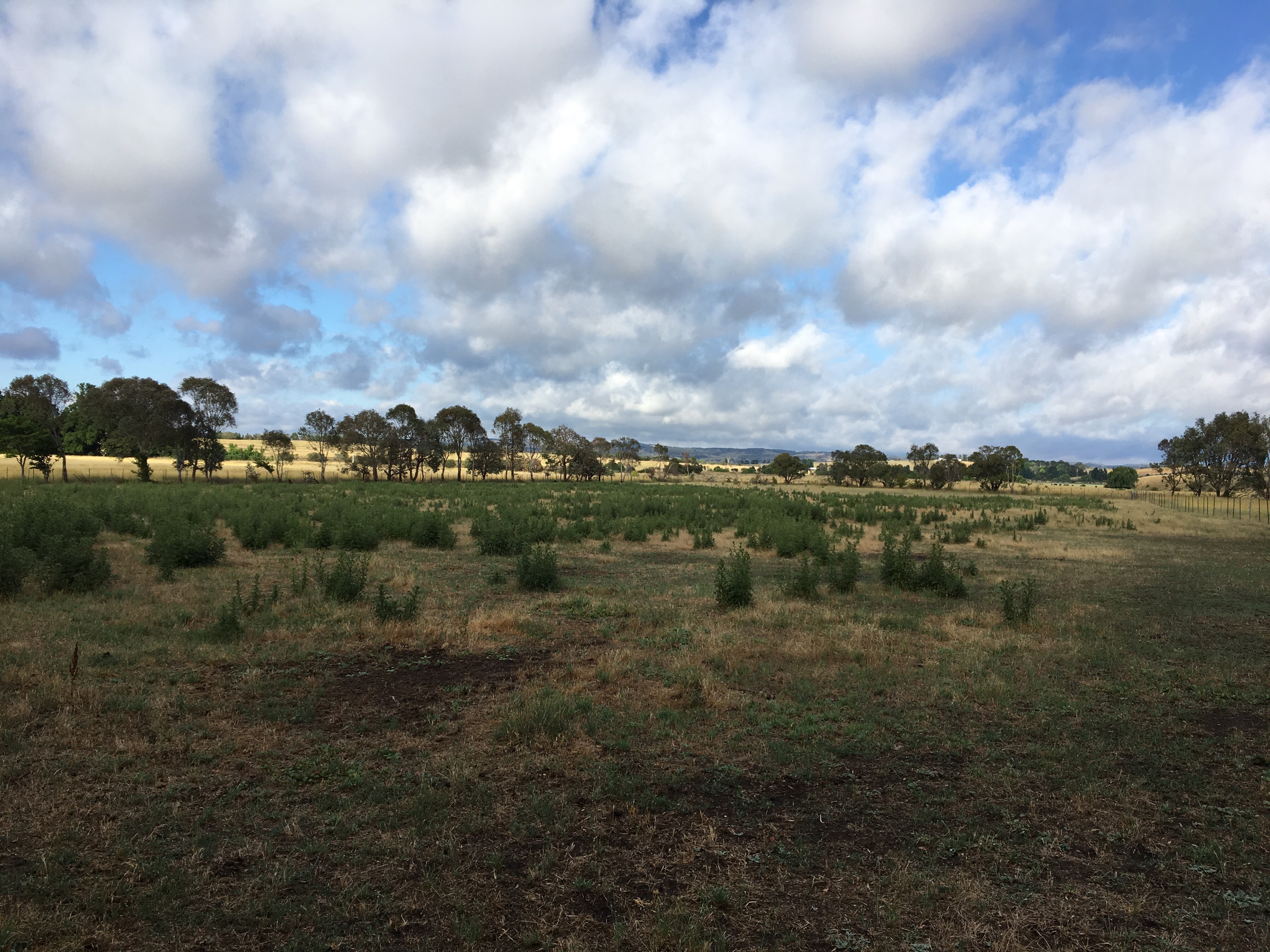
Weed control is one of many competing demands on my time at the new Rock Farm – but I hope to have these plants under control and better managed within a year or so.  If anyone is keen to come and help me chip out some weeds, I’ll gladly shout you lunch!

Managing thistles on the new farm

We are quickly settling into our new property.  The house is starting to feel like a home, and the shed is slowly coming into order.  We might still be deciding where things will live, and I am sure we will rearrange everything a few more times before we are sorted.  We are so excited with the potential of this property – but there are a couple of jobs that can’t wait.

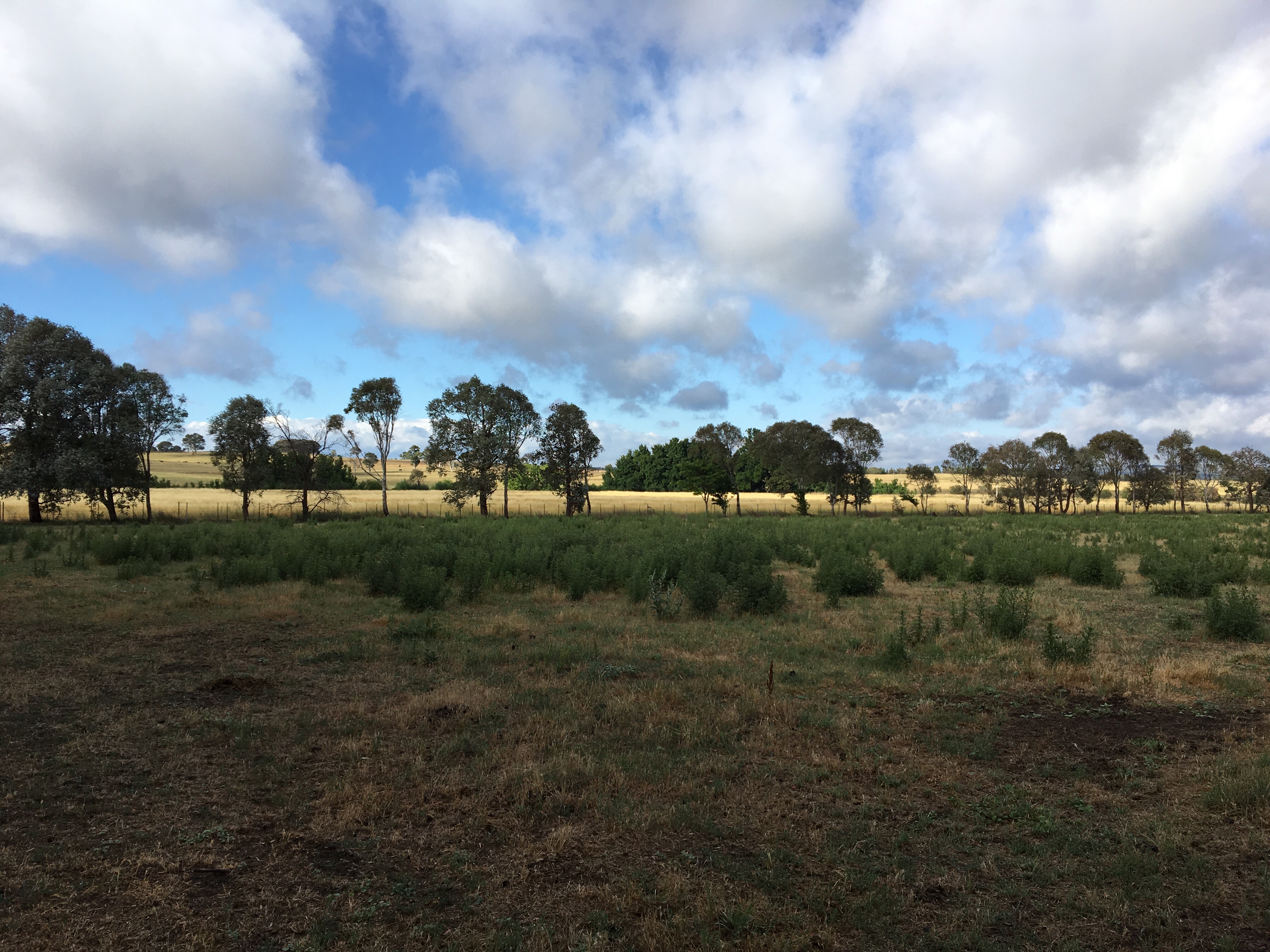
One of our paddocks (1.8 hectares or 4.5 acres) had a healthy crop of thistles green and actively growing.  The only animal I know of that eats thistles like this was Eeyore, of Winnie the Pooh fame.  These thistles were just starting to look ready to flower.  And Eeyore doesn’t live nearby.

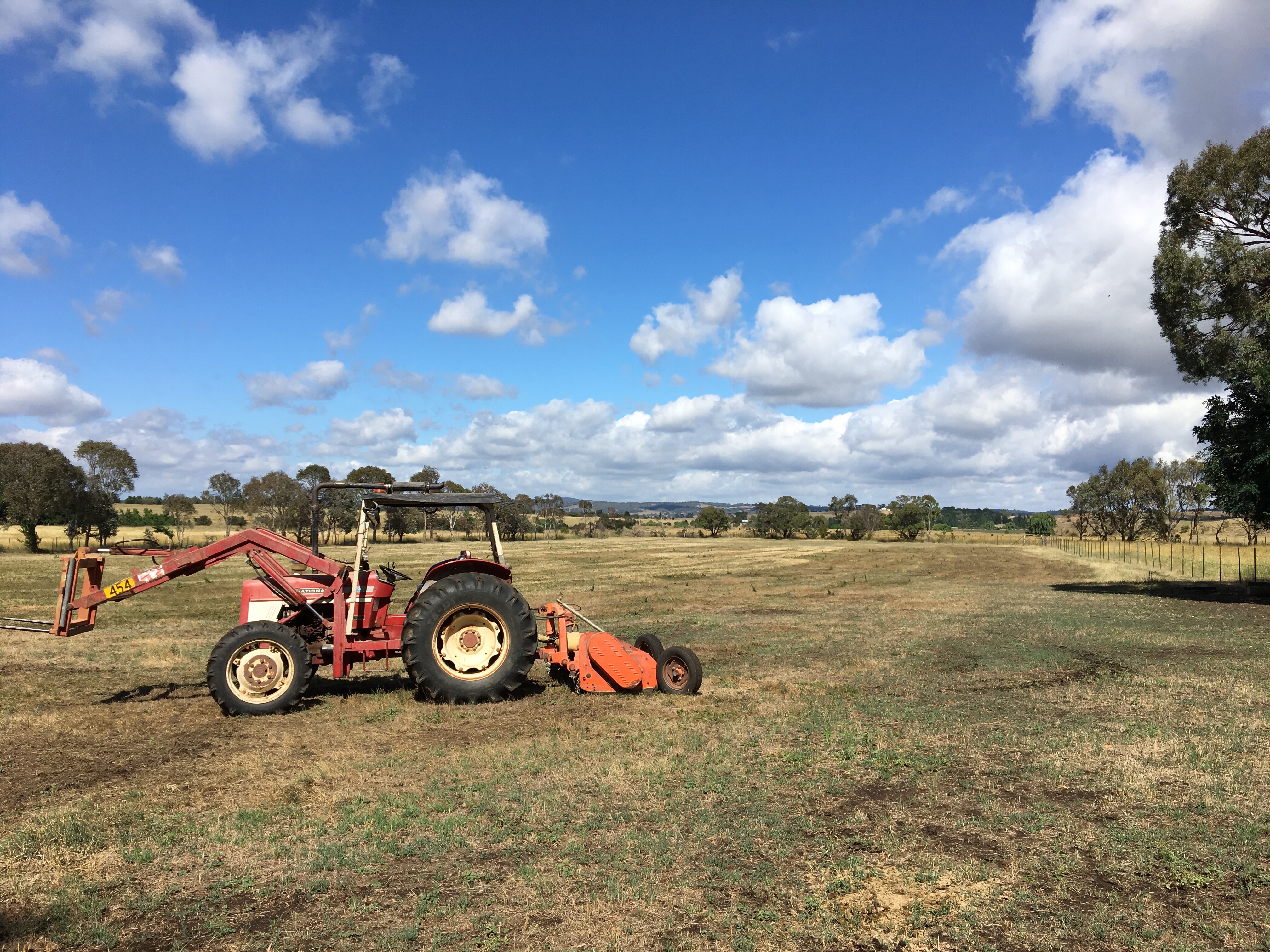
One approach is to poison the thistles with a herbicide, but not wanting to broadcast chemicals over such a wide area, I decided to mechanically mulch the thistles.  This returns the nutrients to the ground, without killing off the microbes and earthworms in the soil.

All I needed was a little patch of rain to dampen the soil and reduce the risk of starting a bushfire.  And on 26th of December, a lovely 16mm of rain fell, giving me an opportunity to mulch the thistles with a much reduced fire risk.

Lucie the tractor and the mulcher made short work of most of the thistles.  In a few of the thicker stands, some stalks remained and a few days later appeared to be still growing, but over 95% of the thistles appear dead.

It is a bit of an experiment.  I don’t know what residual seed bank is in the soil, and how many thistles I will need to manage in this way in the future – but it is nice to try to do it without spraying harsh chemicals on the ground.

I also found the mulcher an extremely effective tool for removing any loose wire on the ground. 😦  Thankfully I only had to stop a couple of times to remove wire from around the drum – and I know have at least one paddock free of loose wire!

That job complete, it was time to get back to the important things of enjoying the summer holidays 🙂